

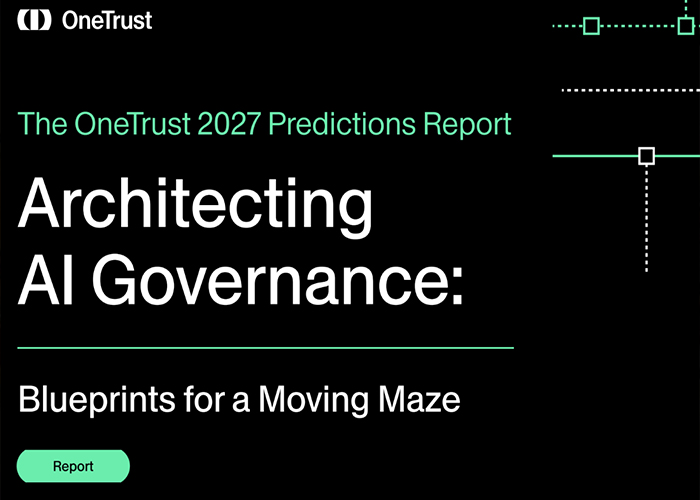
OneTrust has released a 2027 predictions report arguing that Australian organisations will face rising commercial and regulatory pressure to demonstrate that their AI systems are safe, controlled and accountable as AI becomes more autonomous and embedded in operations.
The report, titled Architecting AI Governance: Blueprints for a Moving Maze, draws on input from more than 20 global experts and outlines four developments it says will shape AI adoption and trust in 2027. These include treating AI assurance as a commercial prerequisite, tightening controls on what AI agents are authorised to do, re-assessing approvals when AI systems materially change, and incorporating data-use permissions into AI governance.
OneTrust points to indicators that governance is not keeping pace with adoption. In its 2026 AI-Ready Governance Report, the company said 87% of respondents reported their organisations encourage AI agent use, but only 47% said they have clear governance, oversight and controls in place, while 40% said these capabilities are still developing. In Australia, OneTrust said nearly half (48%) of organisations reported limited visibility into employee-led or unsanctioned AI use, and 52% said concerns about data quality, access, privacy or security have delayed launching or scaling AI initiatives.
The four predictions outlined in the report are:
AI assurance becomes a commercial gate: OneTrust says buyers will increasingly require current evidence that AI systems meet assurance expectations before enabling or expanding capabilities.
An approved AI agent can still take unauthorised action: The report argues technical access to systems does not equate to delegated authority, and calls for clearer boundaries, monitoring and intervention processes.
Material AI changes trigger new assurance events: OneTrust says changes to an AI system’s capabilities, permissions or operating conditions will require organisations to reassess whether approvals and supporting evidence remain valid.
Data-use permissions become part of AI governance: The report argues organisations will need to ensure customer data-use choices are reflected in later AI processing rather than treating consent as a blanket approval.
Blair Hasforth, Regional Vice President Sales, APAC at OneTrust, said: “Australian businesses are under pressure to realise the productivity benefits of AI, but adoption alone is not a measure of success. As AI agents become more capable and connected to business systems, organisations need to understand what they can access, what actions they can take and who is accountable for the outcomes.
“An employee’s access to a system does not automatically mean an AI agent should have the same authority. Businesses need to be deliberate about the boundaries they set and the oversight they put in place, so they can continue to innovate without losing sight of accountability and trust.”
The report also argues that scaling governance through additional headcount or static policies will not be sufficient as AI systems evolve, and calls for governance models that can adapt as technology, use cases and operating conditions change.
You can read the full report here.