

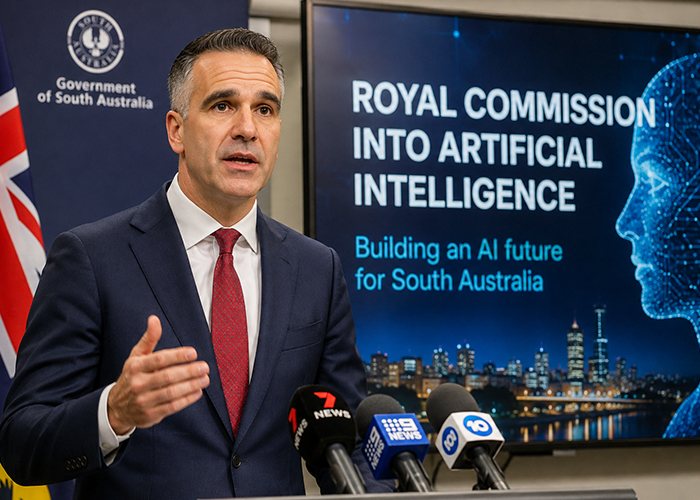
South Australia will establish a Royal Commission into artificial intelligence, with Premier Peter Malinauskas positioning the inquiry as a major examination of how the rapidly advancing technology will reshape the economy, public services and society.
Announced on 10 August, the Royal Commission is expected to begin in October 2026 and deliver its final report by 1 July 2027. The inquiry has an estimated budget of $3 million and will be conducted by a three-member commission with international expertise.
The Commission will examine both the opportunities created by AI and the risks associated with its growing use, including its implications for education, healthcare, industry, government services and the creative sector.
The move reflects the South Australian Government’s increasingly active approach to artificial intelligence policy and investment, with Malinauskas describing AI as a technological transformation comparable in significance to the industrial revolution.
The Royal Commission is expected to consider the economic and social opportunities AI presents for South Australia, appropriate state policy and regulatory settings, national approaches to AI governance and the impact of the technology on critical areas including health and education.
For government and industry, a central question will be how Australia can capture productivity, investment and innovation benefits while establishing safeguards around the way AI systems are developed and deployed.
The inquiry comes as South Australia seeks to establish itself as an Australian centre for AI development and infrastructure.
Earlier this year, the government appointed the inaugural director of its Office for AI, tasked with leading the responsible adoption of artificial intelligence across the South Australian public service. The office has been charged with ensuring AI is used safely and ethically while improving government services, supporting workforce transformation and contributing to economic growth.
South Australia is also pursuing investment in the physical infrastructure required to support large-scale AI.
In June, the government released a data centre strategy designed to attract billions of dollars of investment into the state. The strategy has also brought questions around electricity demand, water consumption and the environmental impact of large AI data centres into sharper focus.
Malinauskas has argued that the development of the sector represents an economic opportunity, particularly for regional South Australia, but that growth must be managed responsibly rather than pursued at the expense of communities or essential resources.
The Premier’s AI agenda gained further momentum during a recent visit to the United States, where he met technology companies and industry leaders. South Australia subsequently signed a memorandum of understanding with OpenAI aimed at exploring opportunities around AI skills, innovation, investment and the broader adoption of the technology.
That combination of investment attraction and regulatory scrutiny places South Australia in an unusual position: the state is simultaneously seeking to accelerate its AI economy while commissioning a wide-ranging examination of how the technology should be governed.
The Royal Commission also follows South Australia’s previous intervention in emerging technology policy, including its examination of the impact of social media and subsequent reforms targeting online harms.
More recently, the state introduced electoral reforms prohibiting AI-generated deepfake political advertisements depicting people performing acts they did not perform without their permission.
For the security and technology sectors, the Commission could have significant implications.
Artificial intelligence is increasingly being embedded into cybersecurity platforms, video analytics, physical security systems, autonomous technologies, identity systems and government decision-making. The resulting policy debate is therefore moving beyond the capabilities of AI models themselves towards questions of accountability, privacy, data governance, human oversight and the reliability of automated decisions.
The Commission is expected to take evidence from a broad range of stakeholders, including technology developers, businesses, academics, unions and representatives of the creative industries, before developing recommendations for government.
With AI adoption accelerating across both the public and private sectors, South Australia’s Royal Commission represents one of Australia’s most substantial state-level attempts to examine the technology’s consequences before its use becomes further embedded across the economy.
The findings, due in July next year, could ultimately have an influence beyond South Australia as governments across Australia consider how to balance AI investment and innovation with security, public trust and effective regulation.