

Australia’s AI transformation is entering a new phase. The conversation is no longer about experimenting with chatbots or testing isolated proof-of-concepts. Instead, organisations are beginning to ask a far more important question: how do we turn artificial intelligence into measurable business outcomes?
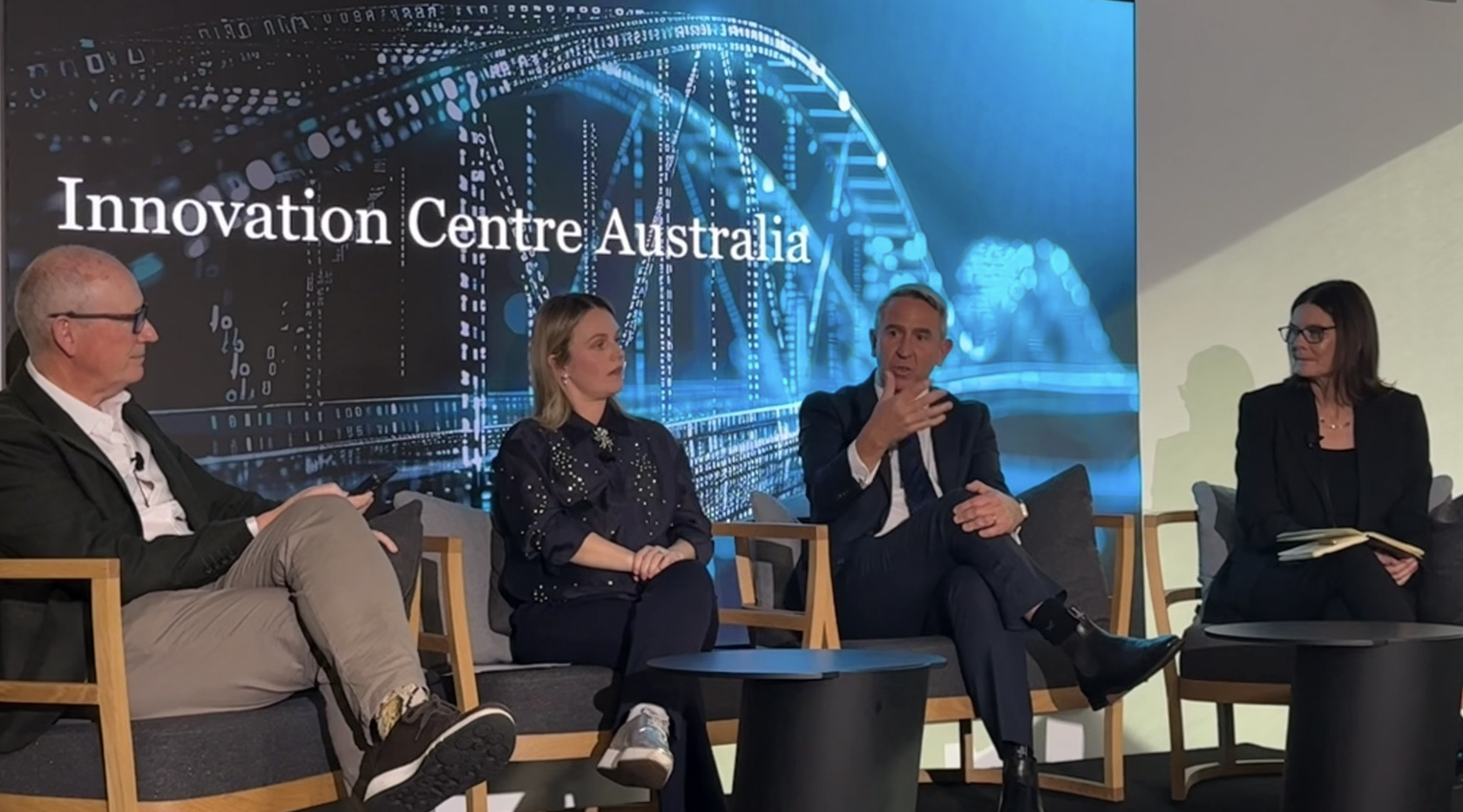
That challenge was at the centre of a panel discussion featuring David McKeering, Executive Managing Director, NTT DATA ANZ, Vanessa Van Beek, Global Chief Information Security Officer (CISO), Fortescue, and Natalie Piucco, Google Field CTO for Applied AI, moderated by Fear & Greed co-host Sean Aylmer during the launch of NTT DATA’s AI Innovation Centre in Sydney.
While the panellists represented enterprise technology, mining and hyperscale cloud services, a common message emerged for smart cities, critical infrastructure operators and local government leaders alike: successful AI adoption will depend less on the technology itself and more on collaboration, governance, trust and courageous leadership.
David McKeering said organisations are now recognising that innovation alone is no longer sufficient. “Innovation in isolation is fine,” he observed, “but if you can do innovation with true collaboration and having that diversity of thought, you’ll get a much better outcome.”
For Australia’s growing smart cities ecosystem, that observation is particularly relevant. Modern cities increasingly rely on interconnected transport systems, utilities, digital services, emergency management and public infrastructure that span multiple organisations and jurisdictions. No single council, technology provider or government agency possesses every capability required to successfully deploy AI at scale.
Instead, McKeering argued that solving complex problems requires bringing together industry, academia, government and technology partners to create genuine collaboration rather than isolated innovation.
Fortescue offered a practical example of what mature AI adoption already looks like. Vanessa Van Beek explained that AI has become embedded across the company’s mining operations, corporate functions, project delivery and decarbonisation strategy. Rather than treating AI as a standalone initiative, Fortescue has integrated intelligent decision-making throughout its operational value chain.
The company is applying AI to optimise drilling decisions, scheduling, ore blending, logistics and equipment utilisation while improving worker safety, productivity and sustainability. Drawing on more than 25 years of operational data, AI models are helping refine decisions that were previously dependent on human judgement and experience.
The results extend well beyond productivity.
Computer vision systems help identify unsafe situations before incidents occur, predictive analytics improve equipment maintenance, and AI is assisting with balancing renewable energy generation against operational demand—demonstrating how AI can simultaneously support operational efficiency and sustainability objectives.
These are the types of integrated applications increasingly being explored by transport authorities, utilities and local governments developing smarter infrastructure.
Natalie Piucco believes the enterprise AI conversation has already shifted dramatically.
“Last year’s AI was a chatbot that you opened and asked a question to,” she explained. “This year’s AI is like a colleague that you delegate an entire workflow to.”
That evolution towards agentic AI—systems capable of autonomously completing complex business processes—is fundamentally changing how organisations think about automation.
Rather than simply answering questions, AI agents are increasingly able to interact with enterprise applications, customer relationship management systems and operational platforms to complete entire workflows.
However, Piucco cautioned organisations against attempting to simply layer AI over existing legacy processes.
Businesses achieving the strongest outcomes are redesigning complete workflows rather than “Frankensteining AI” onto decades-old business practices. For smart city projects, this has significant implications.
Whether deploying intelligent traffic systems, predictive asset management or citizen service platforms, AI is unlikely to deliver transformational benefits if it merely automates existing inefficiencies. Instead, organisations need to rethink how services should operate in an AI-enabled future.
As AI capabilities continue evolving at extraordinary speed—with new foundation models emerging every few weeks—many organisations are questioning how they can realistically keep pace.
Piucco suggested that enterprises should focus less on chasing the latest model and more on building flexible AI platforms capable of incorporating future advances while maintaining governance, security and architectural consistency.
That platform-first approach is likely to resonate strongly with government agencies and infrastructure operators, where procurement cycles and operational lifespans frequently outlast individual AI models.
Security and governance remained recurring themes throughout the discussion.
McKeering highlighted four critical areas organisations must address together: sovereignty, governance, infrastructure and trust.
Trust, he argued, underpins successful AI adoption. Without trusted systems, secure infrastructure and responsible governance, organisations risk eroding both customer confidence and business value.
Van Beek reinforced that governance should enable innovation rather than restrict it. She advocated for “just enough governance”—providing sufficient oversight to understand how AI systems operate, what information they access and how they behave, while allowing organisations to continue innovating at pace. Importantly, she reminded the audience that AI systems differ fundamentally from traditional software. Because AI is probabilistic, organisations require continuous testing, monitoring and assurance. Models evolve, data changes and operational contexts shift, making ongoing validation essential rather than optional.
For operators of smart infrastructure, AI cannot become another “set and forget” deployment.
One of the strongest messages throughout the discussion was that cybersecurity and AI have become inseparable disciplines.
Van Beek described them as being “intertwined like a braid,” arguing that organisations seeking to accelerate AI adoption must simultaneously strengthen cybersecurity if they are to build trusted, resilient systems.
The panel also highlighted cybersecurity’s long-standing culture of collaboration through threat intelligence sharing as a model that broader AI communities could emulate.
Looking ahead, McKeering believes the next stage of AI adoption will depend as much on people as technology.
With AI evolving faster than traditional workforce development can keep pace, stronger partnerships between industry and education providers will be essential to equip future workers with the necessary skills.
Curiosity, he suggested, has become one of the defining leadership qualities in the AI era. Leaders no longer need every answer, but they do need the willingness to continually learn alongside rapidly changing technology.
The panellists agreed that organisations should increasingly focus AI investment on solving genuine business challenges capable of delivering measurable strategic value rather than adopting AI simply because it is available.
For smart cities, that means prioritising practical outcomes such as safer communities, more efficient transport networks, resilient infrastructure, sustainability and improved public services.
The discussion concluded with a message that extends well beyond technology.
Piucco argued that AI readiness is not something organisations eventually achieve.
“Being ready is a decision, not a feeling,” she said. “If you wait for five other people in your industry to do it before you, you’re already too late.”
For Australia’s smart cities sector, the opportunity is becoming increasingly clear. Competitive advantage will not necessarily belong to those with the largest AI budgets, but to organisations willing to collaborate across industries, build trusted foundations and demonstrate the leadership needed to transform AI from experimentation into meaningful public and economic value.